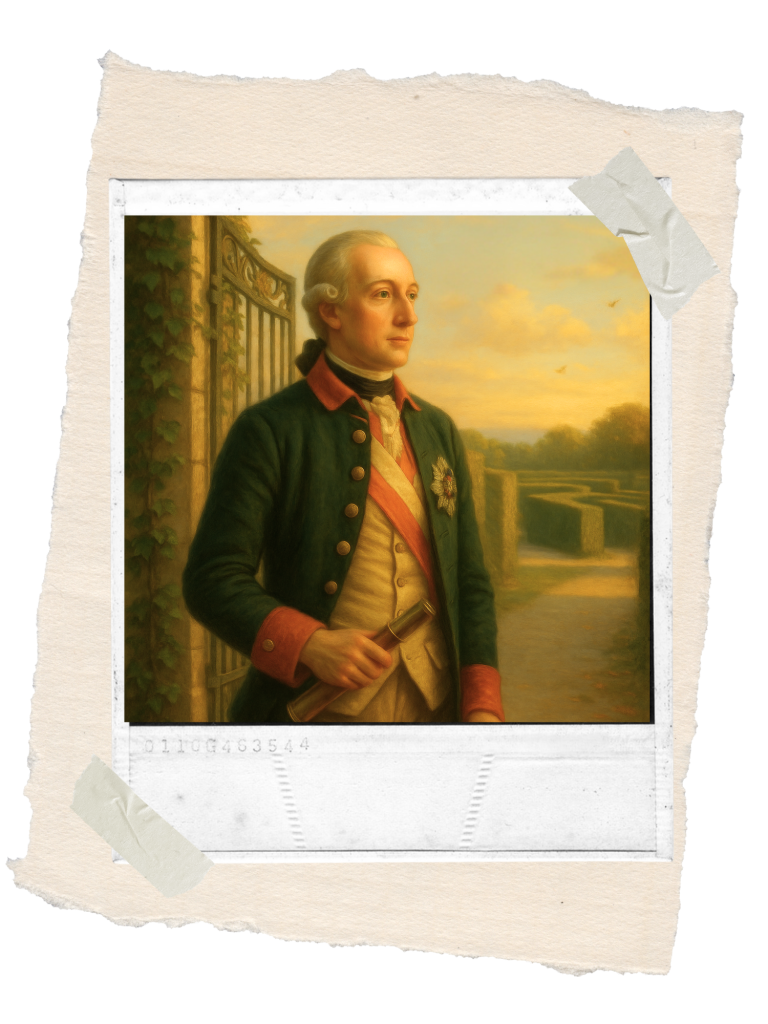

A series exploring the visible and hidden layers of Schönbrunn’s gardens and maze,
imperial order, cultural memory, and the world of The Timekeeper Chronicles.
The Forgotten Gardeners of Schönbrunn Palace
Before the first visitors arrive at Schönbrunn, the gardens have already been prepared. Paths have been leveled, hedges checked, and small corrections made so quietly that the labor behind the landscape almost disappears.
This essay explores the hidden history of the gardeners, apprentices, and workers who sustained Schönbrunn’s imperial grounds and shaped the beauty that visitors still encounter today. It also opens the human world behind The First Whisper and Whispers in the Maze, part of the Timekeeper Chronicles.
The lives that shaped Vienna’s imperial gardens, and the work history rarely records
Before the Gardens Awaken
In the early hours, before the first visitors arrive, the gardens of Schönbrunn exist in a different state.
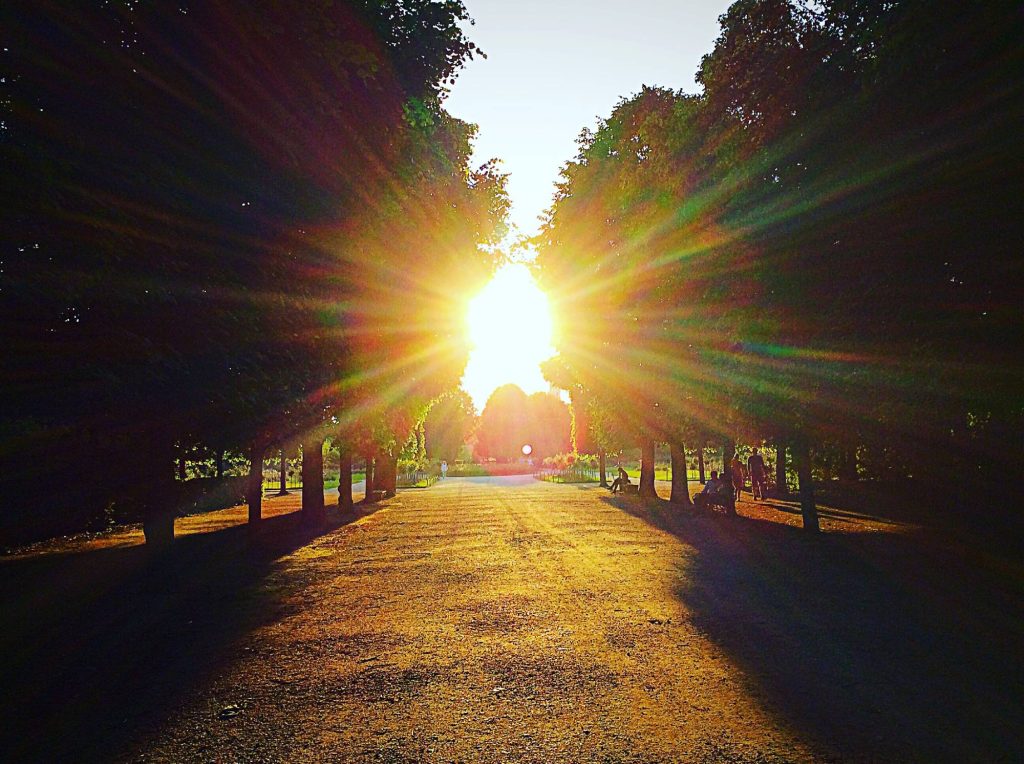
The paths are still. The air holds a faint coolness that will not last long into the day. Light moves slowly across the gravel, touching the edges of hedges that keep their shape even in shadow. Nothing appears unfinished. Nothing seems in motion.
And yet this stillness is not the absence of activity. It is what remains after work has already begun.
Long before the gates open, someone has passed through these spaces. The lines have been checked. The paths have been cleared. Small corrections have been made with such care that they leave almost no visible trace. By the time the garden is seen, it has already been prepared for seeing.
It is easy to experience Schönbrunn as a complete and stable landscape, as though it simply exists in this composed form and has always done so. The symmetry appears permanent. The order feels self-sustaining. Beauty presents itself as if it had arisen naturally.
But the garden is not static.
It depends on repetition, on trained attention, on a kind of labor whose success lies precisely in the fact that it is not meant to draw attention to itself. What looks effortless has already been worked for. What appears settled has already been restored.
The stillness of the morning holds the memory of movement.
By the time the garden is seen, it has already been prepared for seeing.
A Landscape That Depends on Care
As the day begins, the gardens gradually fill with a different kind of motion.
Visitors follow the wide paths that lead away from the palace. They pause along the central axes and turn back to take in the long perspectives that draw architecture and landscape into a single field of vision. The symmetry feels effortless, almost inevitable, as though it belonged to the space by nature.
But this sense of ease is constructed.
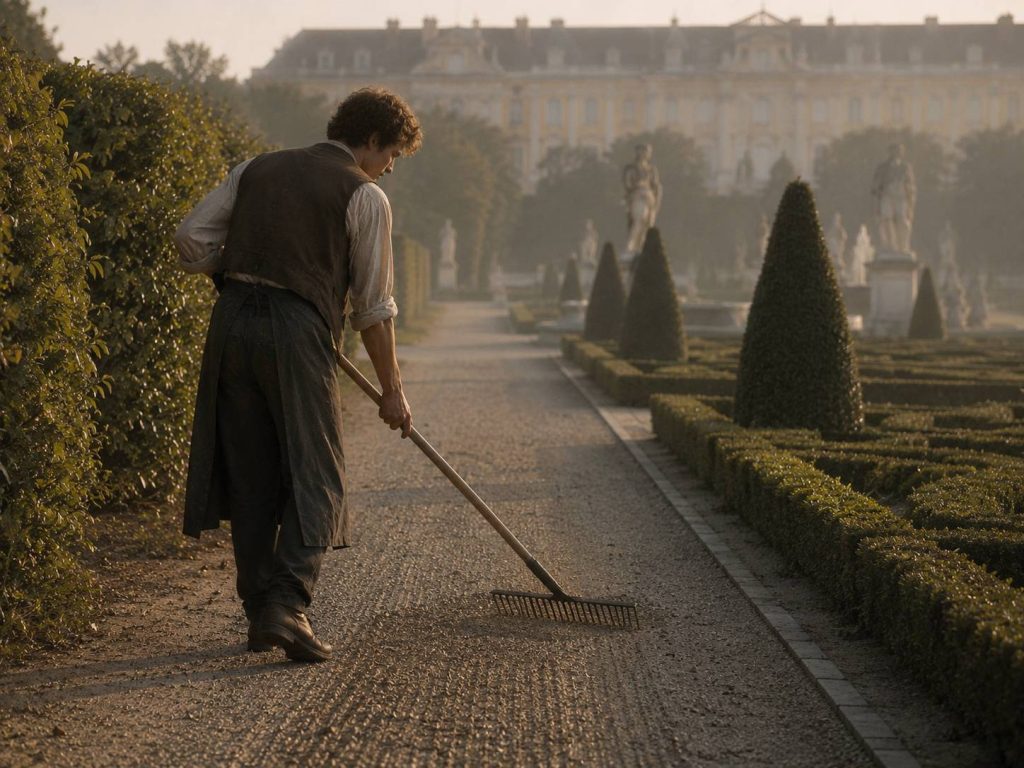
Every surface requires care. Gravel must be leveled so that it settles evenly beneath the feet. Edges must be kept clean if the lines of the garden are to remain clear. Hedges must be trimmed at careful intervals to preserve both their height and their density. Trees must be watched, beds maintained, growth corrected.
For growth does not follow geometry on its own.
Leaves extend beyond their intended boundaries. Paths wear down unevenly under repeated use. Rain shifts surfaces. Wind unsettles edges. Sun, shade, and season all work against the illusion of permanence. Without constant intervention, the order of the garden would begin to soften. The crisp clarity visitors admire would blur at its margins.
What appears fixed is, in fact, continually restored.
And this is one of the quiet paradoxes of formal gardens. The more stable they seem, the more ongoing labor they conceal. Their beauty does not exist apart from work. It is the visible result of work repeated so often, and so precisely, that it begins to disappear into the form it sustains.

The Structure Behind the Beauty
In the eighteenth century, this labor was not incidental. It was organized, structured, and essential to the functioning of the imperial world.
Schönbrunn was not only a residence. It was a carefully maintained environment in which every visible element contributed to a larger system of representation. The gardens extended the authority of the palace into the landscape behind it, reinforcing a sense of continuity between power and space, between rule and visible order.
To sustain such a system required labor at multiple levels.
Gardeners worked within a hierarchy of roles. Experienced supervisors oversaw sections of the grounds, while assistants and apprentices carried out daily tasks under guidance. Knowledge was passed not primarily through written instruction, but through practice. One learned by watching, repeating, adjusting, and gradually acquiring the ability to see what needed to be done before disorder became visible.
The work followed the seasons.
Spring brought preparation and planting. Summer demanded constant trimming, watering, and correction. Autumn required clearing, collecting, and adjustment. Winter introduced a different rhythm, one less concerned with shaping new growth than with preserving structure against damage and decay. The garden changed across the year, but its order had to be carried through those changes without interruption.
It was not enough to design such a landscape once.
Its beauty depended on continuity. Its elegance was not only planned. It was maintained through time, season after season, by people whose work rarely entered the foreground of the story.

When Labor Became Invisible
Despite its importance, this labor left only a faint mark in the official record.
The history of Schönbrunn is usually told through its patrons, its architects, its ceremonial life, and the imperial figures who moved through its rooms and terraces. In such accounts, the garden often appears as a finished achievement: a realized vision, a setting that reflects the intentions of those who commissioned it.
The work that sustained it recedes almost entirely from view.
Gardeners did not usually leave behind extensive written accounts of their days. Their labor was measured not in statements, but in outcomes. A straight path. A clean edge. A hedge that held its line through the season. These were the results that mattered, and they carried no signature.
Over time, the visibility of this work diminished even further. The more successfully the garden achieved its ideal form, the easier it became to overlook the labor required to preserve that form. Stability itself concealed process. The more natural the landscape seemed, the less anyone needed to think about what it took to keep it so.
What remained was the surface.
The process disappeared behind it.
This, too, belongs to the history of imperial beauty. Grandeur is often remembered through what it displays. Much less often through what it requires.
Grandeur is often remembered through what it displays.
Much less often through what it requires.
The Lives That Sustained the Garden
To understand Schönbrunn more fully, it is necessary to imagine the lives that moved quietly within it.
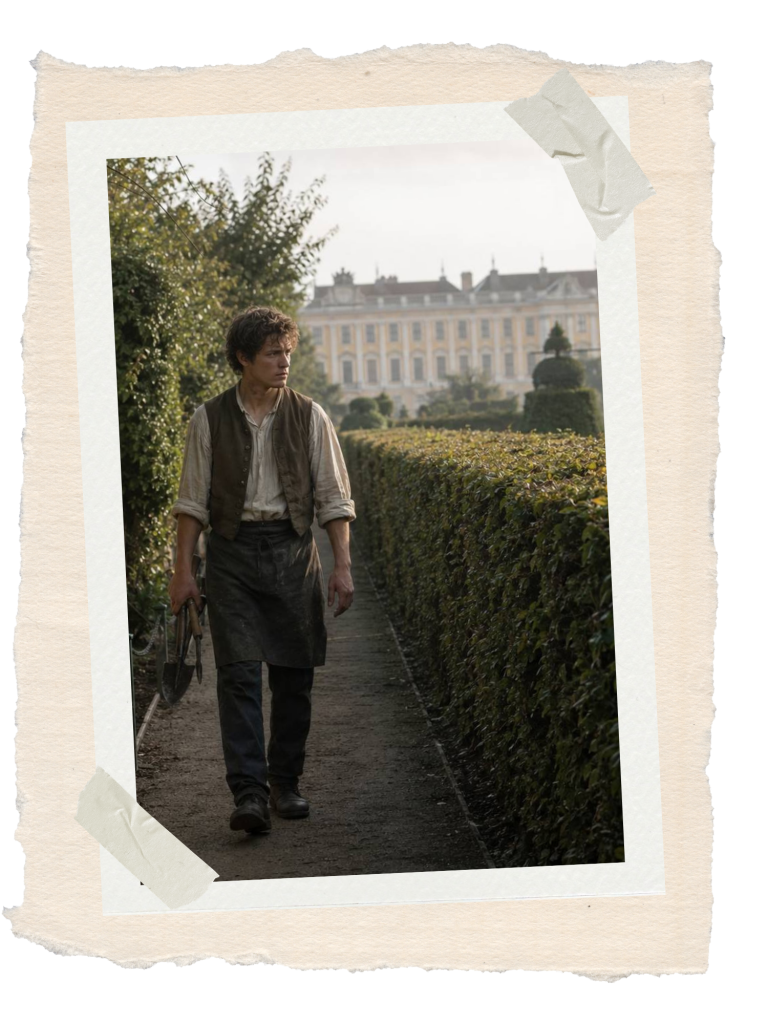
The day began early. Tools were carried across paths that would later fill with visitors. Tasks were assigned, repeated, completed, and then begun again. The work demanded precision, but also patience. It required a long familiarity with growth, weather, timing, and material response, the kind of knowledge that cannot be rushed because it is learned through accumulated attention.
Apprentices learned by observing. They followed more experienced gardeners, gradually taking on responsibility as their eye and hand became steadier. They learned how much to cut and how much to leave. How to shape a hedge so that it would remain dense rather than grow thin. How to read a surface before the day’s traffic made wear visible. How to intervene before imbalance announced itself.
There was little distinction between the visible and invisible aspects of the work. Every act contributed to the whole, even when it left no direct trace. A path leveled before dawn would carry thousands of footsteps without revealing the labor behind its evenness. A hedge trimmed with care would appear not managed, but simply right.
These workers did not determine the overall design of the garden.
But they determined whether that design could continue to exist as lived reality.
Without them, the structure would not hold. The perspectives would blur. The edges would soften. The clarity that now seems so intrinsic to Schönbrunn would begin to dissolve into something looser, less exact, less convincing. Their labor did not merely preserve the garden. It made the garden legible.
From the World of the Timekeeper Chronicles
It is within such a world that another story can begin.
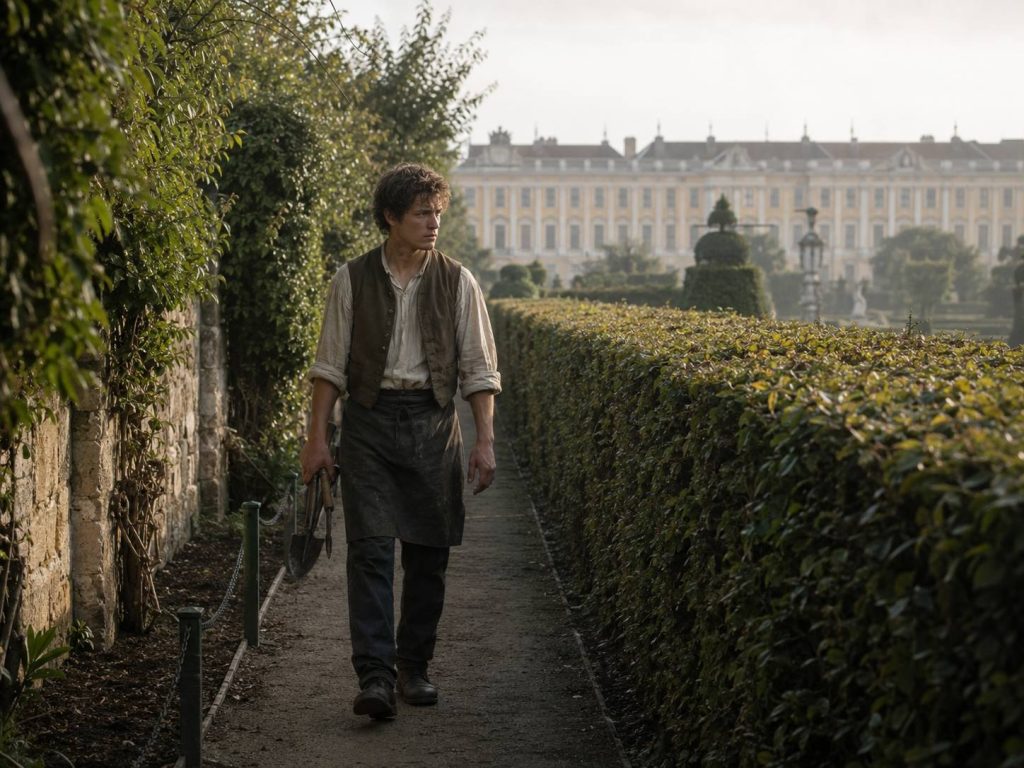
In The First Whisper in the Maze, the gardens of Schönbrunn are not only a setting, but a place of quiet observation shaped by work. Christoph, a young apprentice gardener, moves through the landscape not as a visitor, but as someone responsible for maintaining it. He knows the paths differently. He notices what others pass by.
His knowledge is partial, but it is close.
He sees small irregularities. He notices where the structure of the garden seems to hesitate, where a pattern does not sit quite as it should, where something unexpected appears within a world so carefully kept. This is the kind of attention labor produces: not abstract understanding, but intimate familiarity.
One morning, that attention leads him to a discovery.
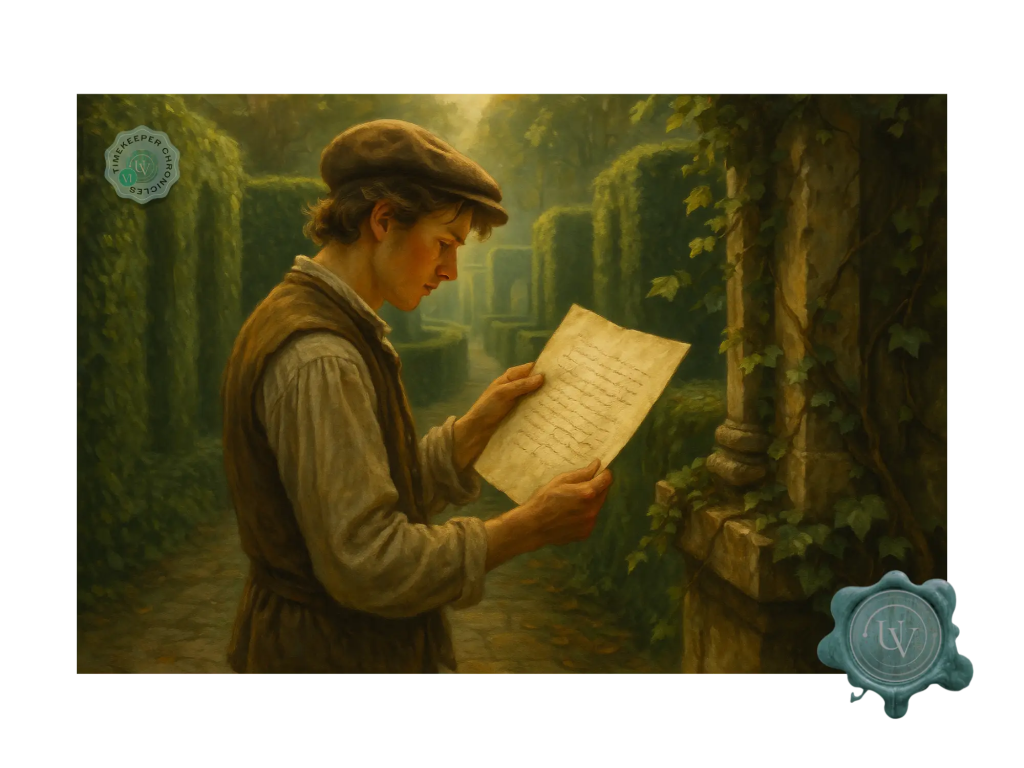
Beneath a stone along one of the narrow passages of the maze, he finds a sealed letter. It has been hidden with care, placed in a way that suggests intention rather than accident. It is not meant for everyone. It is meant, perhaps, for someone capable of noticing what others do not.
What begins as a small and private moment gradually widens. The letter carries ideas shaped by the same changing intellectual world that was beginning to move through Vienna in the age of Joseph II. Through Christoph, the hidden layers of the garden become connected to a much larger atmosphere of reform, secrecy, and historical change.
The garden remains structured.
But within that structure, something else waits.
What the Garden Still Carries
Today, the gardens of Schönbrunn are experienced as a place of openness.
Visitors move freely through spaces whose access once reflected the changing meaning of entry at Schönbrunn. The order of the landscape remains intact, but its meaning has shifted. What was once reserved has become part of a shared cultural life. The grounds are entered not as an extension of courtly privilege, but as one of Vienna’s most beloved public historical spaces.
And yet the conditions that sustain the garden have not disappeared.
The work continues.
Each day, before the first visitors arrive, paths are checked. Edges are restored. Lines are maintained. The same underlying rhythms that shaped the garden in the past continue in the present, even if they are now registered differently and carried out under different historical conditions. The landscape still depends on attention. It still requires care.
Most who walk through Schönbrunn will see only the result: the symmetry, the balance, the clarity that gives the grounds their calm authority.
A few may begin to notice something more.
That beneath the visible order lies a continuous act of maintenance. That the garden is not only a design, but an ongoing process. And that what appears stable is in fact sustained moment by moment by lives that move quietly through it, leaving almost nothing behind except the form itself.
Perhaps that is one of the deepest truths such a place can still teach.
That beauty is not always a finished thing.
Sometimes it is a discipline of care, repeated so faithfully over time that history forgets the hands that held it in place.

Author Note
As the founder of Understanding Vienna, Yolanda Reischer-Bohanec writes about Vienna as a city of memory, beauty, hidden passage, and historical layers. A central part of her work returns to Schönbrunn: its gardens, quieter paths, unseen working worlds, and the stories that lie behind the imperial surface.
This essay is part of the Schönbrunn Essays series and also opens the historical and imaginative ground behind The First Whisper, a story world rooted in Schönbrunn, memory, and hidden passage.

Continue the Journey
Read Vienna Beneath the Surface
Receive The Understanding Vienna Field Guide: 7 Ways to Read Vienna Beneath the Surface
and learn 7 ways to notice hidden stories, symbols, thresholds, memory, and the deeper layers of the city.
You’ll also receive occasional Understanding Vienna letters. Unsubscribe anytime.

The Hidden Vienna Post
A future paid literary letter subscription from the quieter rooms of Vienna.
A monthly mail club for readers, travellers, and lovers of hidden places, with seasonal letters, small paper treasures, cultural fragments, and notes from the city’s layered archive.
The Hidden Meanings of the Schönbrunn Maze
Vienna as a Symbolic World: Why Place Carries Memory
History of Sommerfrische: Vienna’s Summer Tradition
The Forgotten Gardeners of Schönbrunn Palace