

A series exploring the visible and hidden layers of Schönbrunn’s gardens,
Schönbrunn maze history, imperial order, cultural memory, and the world of The Timekeeper Chronicles.
The Hidden Meanings of the Schönbrunn Maze
The maze at Schönbrunn Palace is more than a garden amusement. Hidden within the ordered beauty of the palace grounds is a space shaped by Baroque design, Enlightenment curiosity, and the quiet labor of those who maintained it.
This essay explores the history and meaning of the Schönbrunn maze and the eighteenth-century world in which it was created. It also introduces the historical atmosphere behind The First Whisper and Whispers in the Maze, part of the Timekeeper Chronicles.
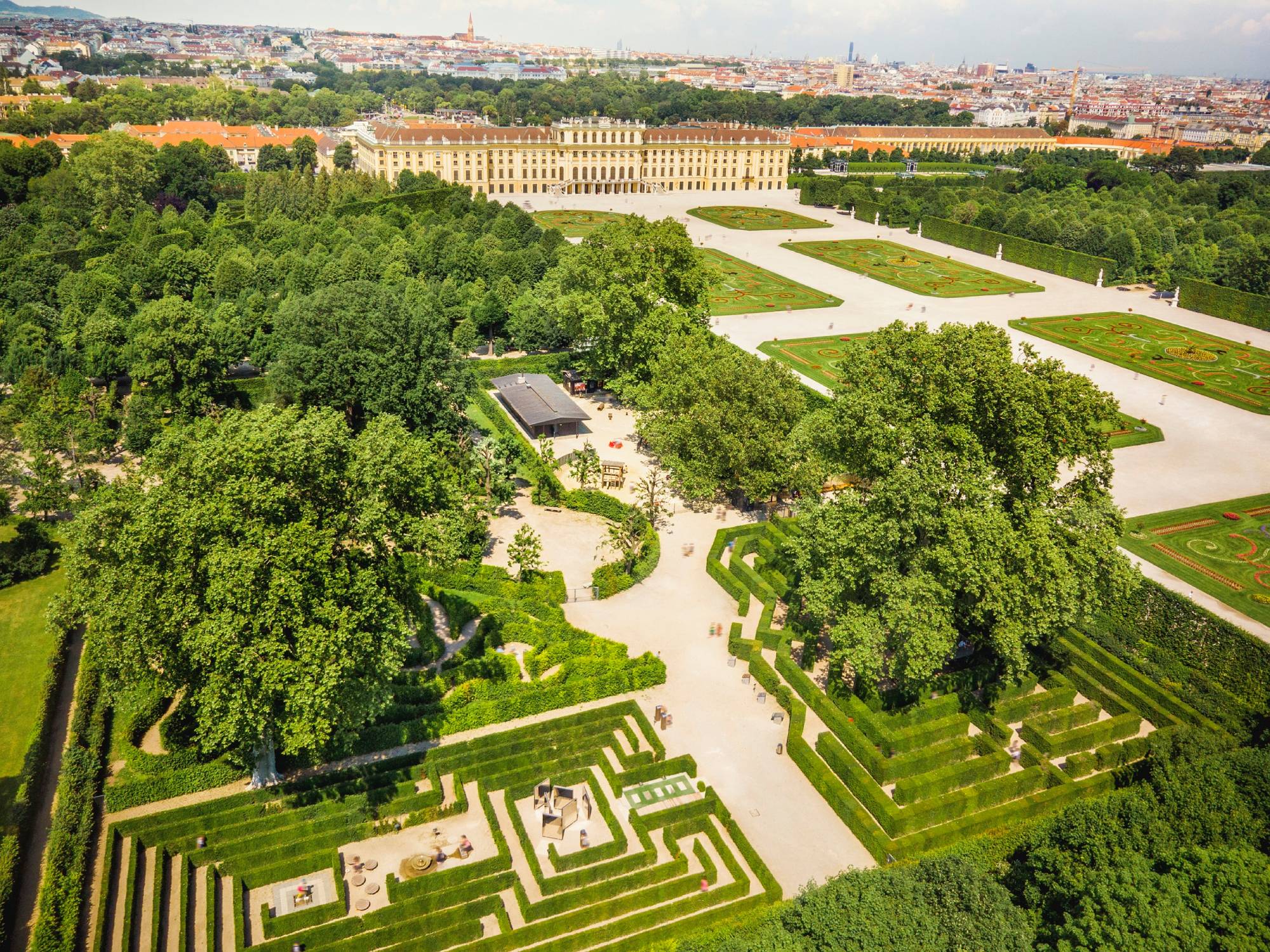
SCHÖNBRUNN PALACE, MAZE AND LABYRINTH
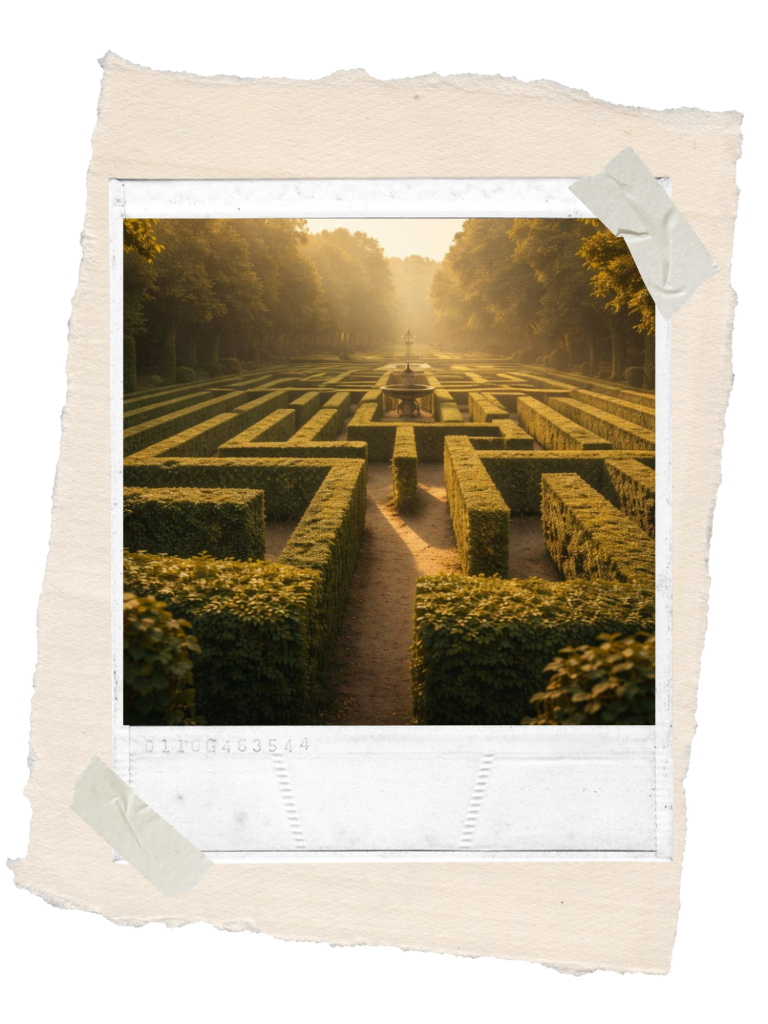
From above, the Schönbrunn maze appears perfectly ordered. From within, its paths tell a more uncertain story.
© Schloß Schönbrunn Kultur- und Betriebsges.m.b.H., Severin Wurnig
A Baroque garden puzzle shaped by power, philosophy, labor, and memory
Early in the morning, before the first tour groups begin to gather at Schönbrunn Palace, the maze is almost silent.
A thin veil of mist sometimes lingers above the hedges, softening the strict geometry of the garden. The gravel paths remain undisturbed. Somewhere beyond the green walls, a rake moves slowly across the ground. The sound is faint, almost absorbed by the stillness around it.
At first glance, the maze appears perfectly rational. From above, its design is balanced, measured, and clear. Like so much of the Baroque landscape surrounding it, it seems to express a reassuring faith in order: the belief that nature can be shaped, arranged, and persuaded into harmony with human intention.
Yet the experience changes the moment one steps inside.
The hedges rise higher than expected and quietly close off the wider world. The palace disappears. The city disappears. A path bends to the left, then to the right. One turn leads to another. What seemed so legible from a distance becomes uncertain at ground level. Even now, that small shift remains part of the maze’s enduring charm. It asks us to exchange overview for experience, certainty for attention.
Visitors laugh when they meet a dead end. Children run ahead with the confidence of those who are certain they have already understood the pattern. For many, the maze is a pleasant diversion within the gardens of Schönbrunn, an interval of play during a palace visit.
And yet it was never only that.
Like much of Vienna’s imperial landscape, the maze belongs to a world of ideas. It was shaped not only as amusement, but as part of a larger vision of order, curiosity, cultivated pleasure, and human design.
It asks us to exchange overview for experience, certainty for attention.
A Maze in the Imperial Gardens
The maze occupies only one corner of the vast grounds that unfold behind Schönbrunn Palace. Yet within that corner lies the logic of the larger whole.
These gardens were never intended merely as places for strolling. They were composed landscapes, carefully designed to express a particular way of seeing the world. When Maria Theresa transformed Schönbrunn into the principal summer residence of the Habsburg court in the eighteenth century, the surrounding grounds became part of the imperial stage itself. The palace did not end at its walls. Its authority extended outward into avenues, terraces, parterres, sculptures, fountains, and controlled vistas, until landscape and architecture spoke in a single language.
That language was one of order.
Long gravel paths were drawn across the earth with deliberate precision. Flower beds formed intricate ornamental patterns best appreciated from above. Trees were planted not only for shade, but for symmetry and perspective. Even distance was shaped. The eye was guided, directed, composed.
To walk through such a garden was therefore to move through an idea as much as through a landscape. Nature was not abandoned to wildness. It was refined, framed, and disciplined into visible harmony.
Visitors today still feel this, even if only intuitively. The broad paths, the clipped hedges, the fountains, the long axial views toward the Gloriette all suggest a world in which beauty and control were meant to reinforce one another. The garden offered pleasure, certainly, but also instruction. It showed what order could look like when power had the means to shape it.
Within this setting, the maze introduces a subtle and delightful complication.
From above, it remains obedient to the same geometric discipline as the wider garden. Its design is balanced, elegant, and composed. But once inside, the experience shifts. The clear pattern disappears into enclosure. The palace vanishes behind walls of green. The path offers no explanation. One must continue by walking.
That, too, was part of its appeal. Across Europe, garden mazes offered aristocratic visitors a controlled kind of uncertainty. They turned walking into a puzzle, and the landscape into a form of gentle challenge. Even within a world designed to display perfect order, the individual still had to find the way through.
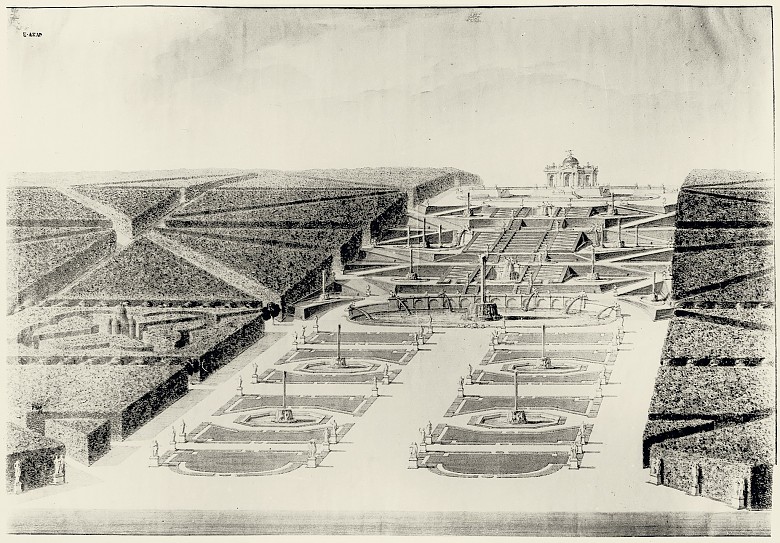
Carl Schütz, copperplate engraving (c. 1772) of Johann Ferdinand Hetzendorf von Hohenberg’s
design proposal for the Schönbrunn Palace Great Parterre and Hill.
Image via Österreichische Nationalbibliothek
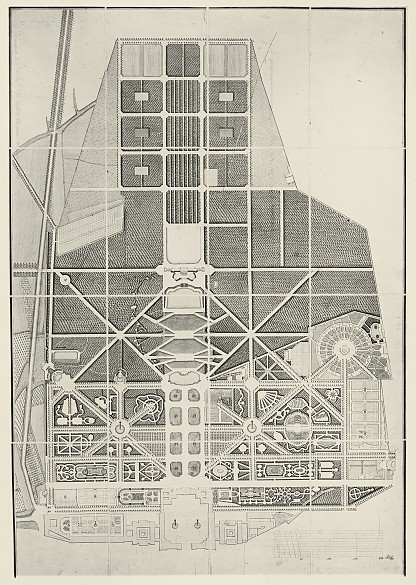
Image via Österreichische Nationalbibliothek
It asks us to exchange overview for expeo walk through such a garden was therefore to move through an idea as much as through a landscape.rience, certainty for attention.
Why European Gardens Built Labyrinths
The maze at Schönbrunn belongs to a much older human fascination.
Long before labyrinths entered palace gardens, they had already taken root in story, ritual, and imagination. Some of the earliest and most enduring images come from the ancient Mediterranean world. In Greek mythology, the labyrinth of Crete was built to contain the Minotaur, and the hero Theseus entered it knowing that once inside, direction itself could no longer be trusted. He survived, according to the story, only because Ariadne gave him a thread by which he could find his way back.
Whether read as myth, symbol, or inherited cultural memory, the image proved remarkably durable. The labyrinth came to signify more than entrapment. It suggested a journey that required patience, concentration, courage, and the willingness to proceed without seeing the whole at once.
In the Middle Ages, labyrinth patterns appeared in the floors of European cathedrals, where they took on a more inward meaning. Pilgrims walked them slowly as acts of devotion or meditation. Here, the winding path no longer guarded a monster. It became a figure for spiritual passage, a bodily form of contemplation.
By the seventeenth and eighteenth centuries, when the great formal gardens of Europe were being designed, the labyrinth had acquired yet another life. It moved from cathedral floor to cultivated landscape, from explicitly sacred symbol to courtly pleasure. But it did not lose its deeper associations entirely. It retained something of the older invitation: to move forward without total certainty, to discover by walking, to submit for a time to a path whose meaning emerges only gradually.
This is where the maze enters the intellectual atmosphere of the Enlightenment.
The eighteenth century valued curiosity. It encouraged close observation of the natural world, confidence in reason, and a belief that understanding could be gained through inquiry rather than received passively. In such a climate, the maze became more than a decorative amusement. It turned movement into experiment. It made discovery playful.
Even today, when visitors step into the maze at Schönbrunn, they enter this older tradition almost without realizing it. For a few minutes, the path becomes an invitation to wonder not only where the next turn may lead, but where the road ahead, and life itself, may be asking us to go.
And once that question begins to stir, the maze can no longer be understood only as a garden feature. It belongs, more fully, to the world of thought that shaped eighteenth-century Vienna itself.
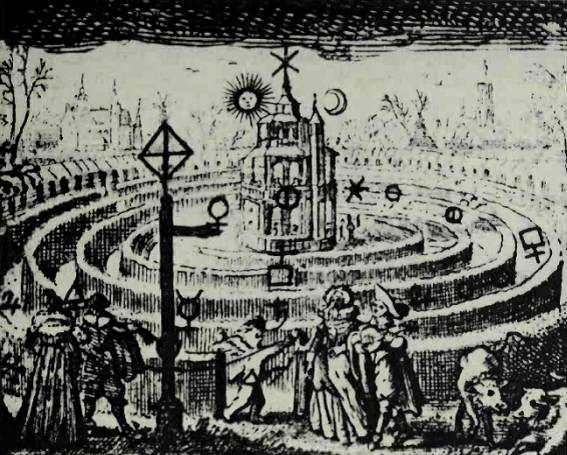
Goossen van Vreeswijk, ‘The Lapis Sanctuary’ (The Hermetic Labyrinth), copperplate engraving from ‘De Goude Leeuw,’ 1674.
Enlightenment Vienna
To understand the maze more deeply, we have to step for a moment beyond its hedges and into the city that gave such landscapes their meaning.
In the eighteenth century, Vienna was not only an imperial capital of ceremony, administration, and dynastic power. It was also a city increasingly alive with ideas. Across Europe, the Enlightenment encouraged scholars, officials, writers, and reformers to ask new questions about society, education, religion, law, and the natural world. Observation, reason, and debate were treated not as threats to order, but as instruments through which order might be improved.
Vienna participated actively in this intellectual movement, even if always in its own imperial and Catholic way. It was a center of governance within the Habsburg monarchy, but also a place where music, scholarship, diplomacy, and reform-minded conversation circulated through salons, courtly networks, institutions, and administrative life. The city absorbed the energies of the age while filtering them through its own political realities.
One of the central figures in this world was Emperor Joseph II.
Joseph II is remembered as one of Europe’s so-called enlightened rulers, a monarch who believed that government should be guided by rational principles and that institutions could be examined and reformed in the service of broader public good. Not all of his reforms were welcomed. Many provoked resistance, frustration, or outright opposition. Yet the spirit behind them remains characteristic of the age: the conviction that inherited structures could be questioned, and that society itself might be reshaped through deliberate thought.
Seen in that light, the maze begins to appear differently.
It remains playful, yes. It still offers laughter, hesitation, and delight. But it also belongs to a culture that valued cultivated curiosity. Its winding passages mirror, in miniature, a world that increasingly believed knowledge was not simply bestowed from above, but pursued through observation, inquiry, and the testing of one’s way forward.
In that sense, the maze is not separate from Enlightenment Vienna. It is one of its quieter expressions.
Long before the first curious visitor entered laughing, someone had already walked those same paths with pruning shears in hand.
The People Who Maintained the Maze
And yet ideas alone do not sustain a garden.
It is easy, when walking through Schönbrunn, to experience the landscape as if it had arranged itself into harmony. The hedges appear perfectly trimmed. The paths feel calm beneath the feet. Fountains stand where they should. Trees hold their lines. Everything seems composed with such ease that the labor behind it almost disappears.
But places like this have always depended on constant care.
Hedges must be cut and shaped repeatedly if they are to remain dense and even. Gravel paths need raking, edging, leveling, and repair. Trees, flower beds, and planted borders demand different kinds of attention in different seasons. A formal garden does not remain formal by accident. Its order has to be renewed, day after day, by those whose work often enters history only faintly, if at all.
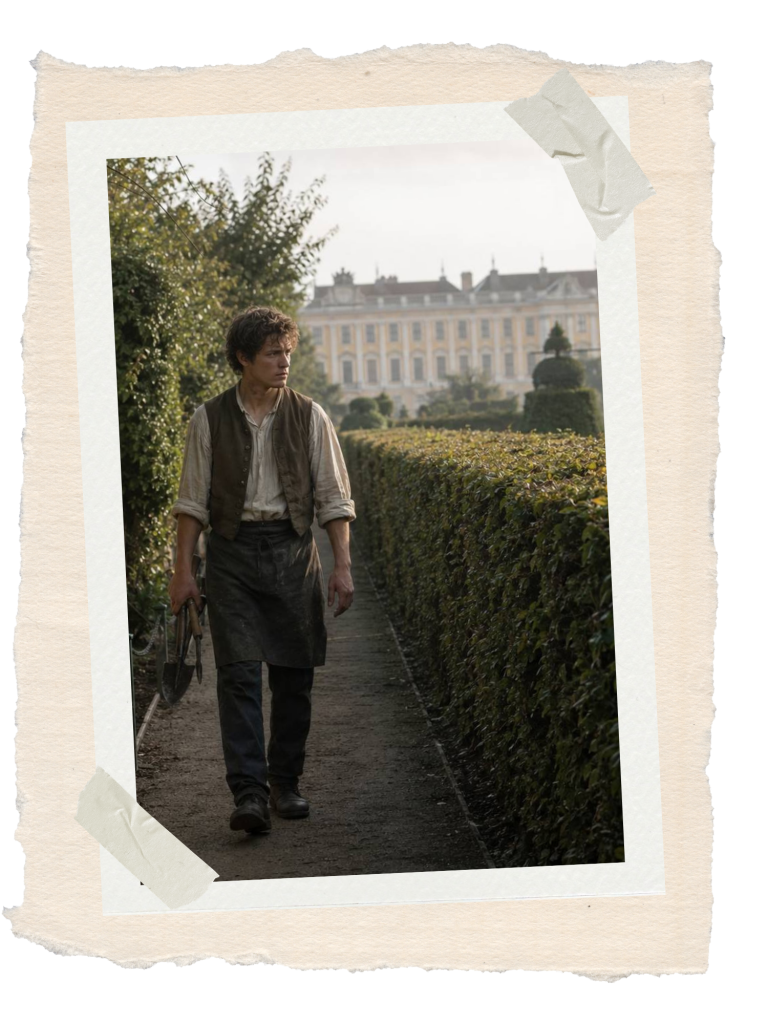
In the eighteenth century, that work fell to teams of skilled gardeners, assistants, and apprentices who spent much of their lives within the palace grounds. For them, the garden was not a spectacle first. It was a workplace, a discipline, and often a kind of education.
An apprentice learned by doing. He learned how to cut a hedge so that it would thicken properly rather than grow sparse. He learned how sunlight moved across terraces and walls, where moisture lingered, how weather altered the condition of the soil, and how each season required a different rhythm of care. He came to know not only the grand avenues admired by visitors, but also the hidden corners, service paths, toolsheds, and less celebrated edges of the grounds.
The maze would have demanded particular patience. Its tall hedges required careful trimming to preserve both density and form. Its narrow passages magnified irregularities. A lapse of attention would have shown at once.
Long before the first curious visitor entered laughing, someone had already walked those same paths with pruning shears in hand.
That quiet fact changes the atmosphere of the place. The maze is not only a design, nor only a symbol, nor only a site of courtly play. It is also the result of repeated human care. Beneath its elegance lies labor. Beneath its puzzle lies maintenance. Beneath the visible order stands a world of routine, apprenticeship, and skilled attention without which the experience would never have existed at all.
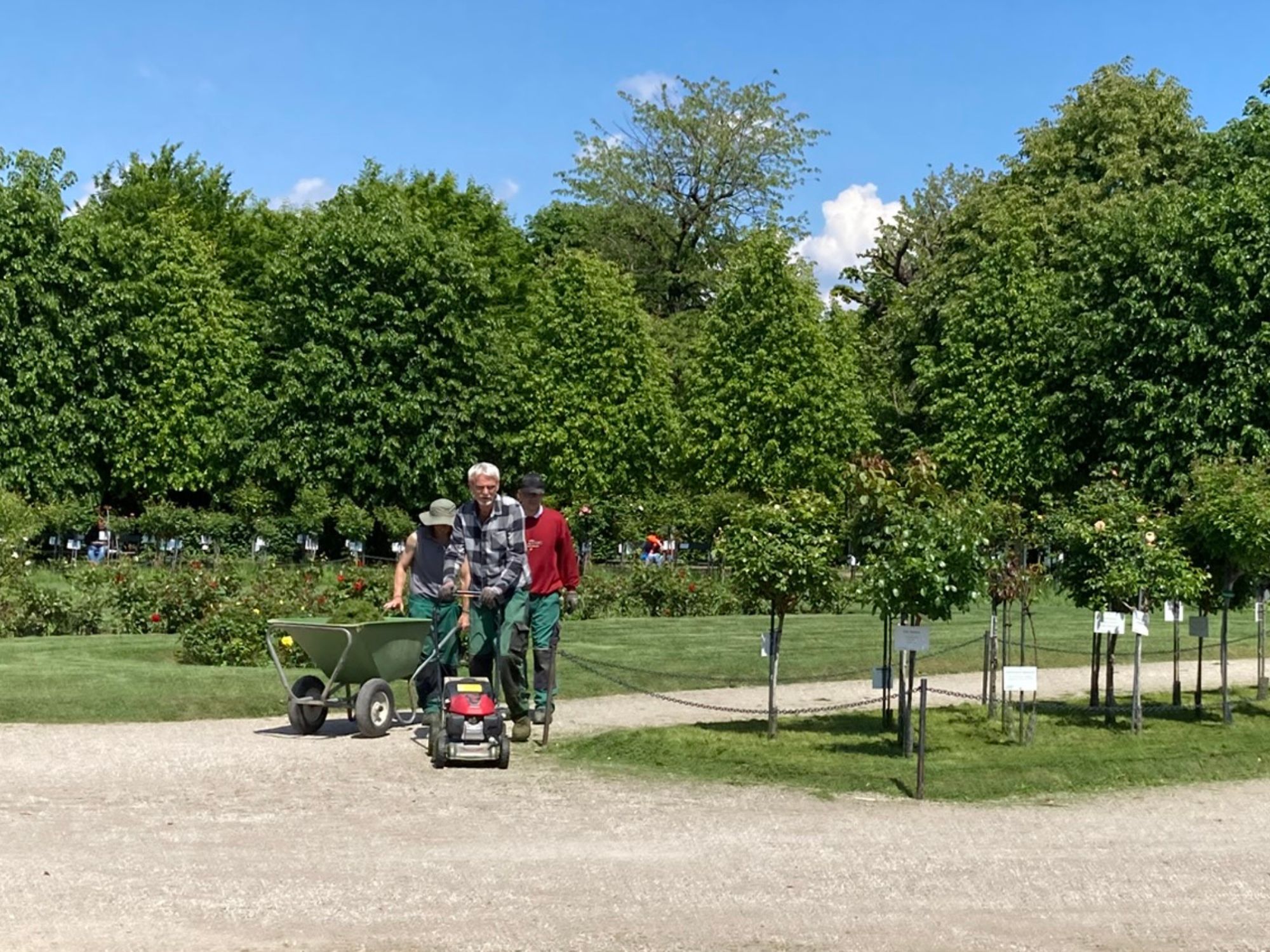
Gardener working in the gardens of Schönbrunn Palace.
Photo Yolanda Reischer-Bohanec Understanding Vienna
The Maze as an Intellectual Puzzle
Once we begin to see both its design and its labor, the maze reveals another layer of meaning.
In a landscape otherwise governed by broad lines, open views, and commanding symmetry, the maze introduces partial knowledge. From the palace terraces, the garden appears fully legible. From within the maze, nothing can be grasped all at once. The walker sees only the next turning, the next possibility, the next correction.
This is part of what makes the maze feel so strangely modern, even now.
Its logic recalls a central habit of Enlightenment thought: the belief that understanding is not always immediate, and that one reaches it through sequence, observation, testing, and revision. Knowledge is not handed over whole. It is approached. One advances, adjusts, notices, and tries again.
The maze gives that process physical form.
Inside its narrow passages, the body learns what the mind of the age increasingly trusted: that discovery often proceeds step by step, and that clarity is sometimes earned only after one has passed through uncertainty. What seems at first a game therefore carries a more serious undertone. The walker is not only entertained. The walker is gently trained in a way of attending.
Seen this way, the maze becomes more than a decorative curiosity in an imperial garden. It becomes a small theater of inquiry, a place where movement, perception, and thought briefly converge.
From the World of the Timekeeper Chronicles
And perhaps that is why places like this so readily invite story.
A maze is never only what it shows at first glance. Its visible form is precise, but its experience is made of delay, concealment, misdirection, return, and the quiet possibility that something may be waiting just beyond the next turn. It is a place where an ordinary morning can feel, for a moment, as though it might open into something else.
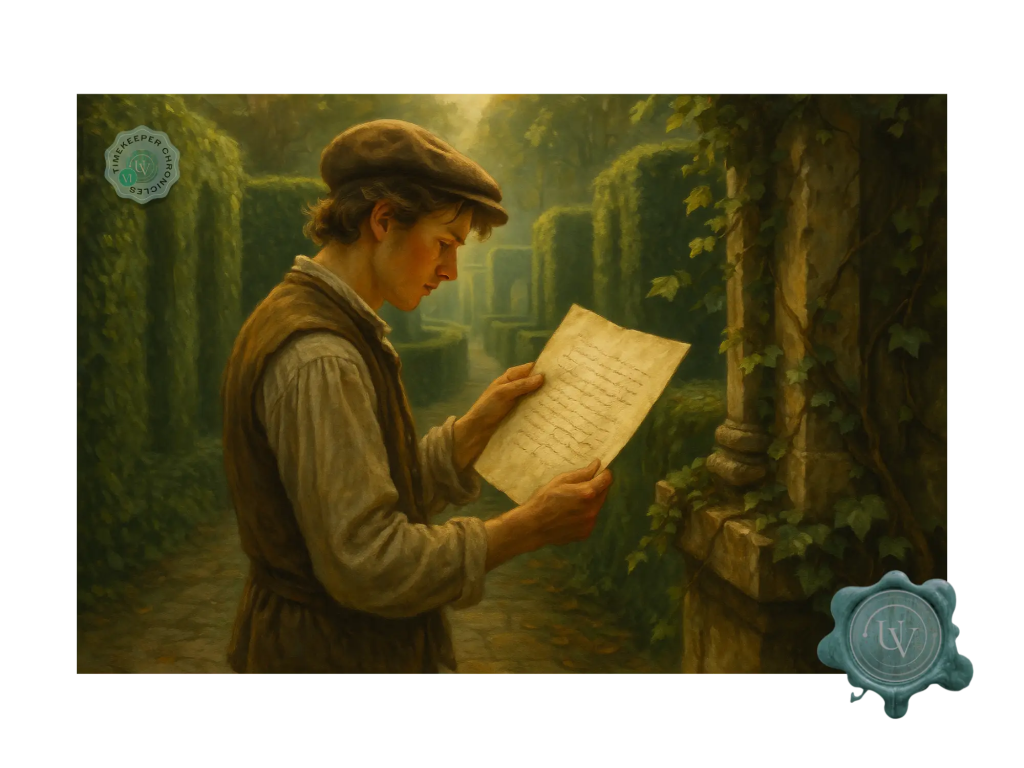
The historical world surrounding Schönbrunn’s maze shaped the prelude story The First Whisper, part of the Timekeeper Chronicles. There, the garden becomes the workplace of a young apprentice gardener named Christoph, who knows its paths not as diversion, but as duty. One morning, while tending the hedges, he notices something unusual beneath a loose stone in one of the narrow passages: a small sealed letter, hidden so carefully that it seems to have been waiting not merely to be found, but to be found by the right hands.
From such a detail, a story begins to stir.
Not because history needs to be embellished, but because certain places already carry the structure of narrative within them. A path. A turning. A hidden object. A question. A world of reform and unease just beyond the hedge. The maze, in this sense, does what the best historical places often do: it holds fact and possibility close together.
Sometimes, if we are attentive, the path offers more than an exit.
Closing Reflection
Today, the maze at Schönbrunn is filled less with courtly intrigue than with laughter, sunlight, footsteps, and the cheerful determination of visitors trying to guess the pattern before the path reveals it.
And yet something of its older life remains.
From above, it still appears orderly and composed, as though the whole could be understood at a glance. From within, it still asks for patience. The hedges still interrupt certainty. The path still narrows perception before widening it again. What changes is not the structure, but the person walking through it.
Perhaps that is part of why the maze continues to speak across centuries. It reminds us that places are rarely exhausted by their surface function. A garden feature can also be a philosophical echo. A pleasant diversion can also carry the imprint of empire, reform, labor, design, and the quiet habits of attention. A narrow path between hedges can still awaken questions larger than itself.
So when we step into the maze today, we do more than enter a historical attraction.
We enter a small architecture of uncertainty, shaped by power, maintained by unseen hands, animated by curiosity, and preserved by time. For a few minutes, we surrender the comfort of overview and walk instead by turning, noticing, correcting, and continuing.
And sometimes, if we are attentive, the path offers more than an exit.
It offers the fleeting sense that history is not only behind us, but still waiting, quietly, within the walls.

Author Note
As the founder of Understanding Vienna, Yolanda Reischer-Bohanec writes about Vienna as a city of memory, beauty, hidden passage, and historical layers. A central part of her work returns to Schönbrunn: its gardens, quieter paths, unseen working worlds, and the stories that lie behind the imperial surface.
This essay is part of the Schönbrunn Essays series and also opens the historical and imaginative ground behind The First Whisper, a story world rooted in Schönbrunn, memory, and hidden passage.

Continue the Journey
Read Vienna Beneath the Surface
Receive The Understanding Vienna Field Guide: 7 Ways to Read Vienna Beneath the Surface
and learn 7 ways to notice hidden stories, symbols, thresholds, memory, and the deeper layers of the city.
You’ll also receive occasional Understanding Vienna letters. Unsubscribe anytime.

The Hidden Vienna Post
A future paid literary letter subscription from the quieter rooms of Vienna.
A monthly mail club for readers, travellers, and lovers of hidden places, with seasonal letters, small paper treasures, cultural fragments, and notes from the city’s layered archive.
History of Sommerfrische: Vienna’s Summer Tradition
When Joseph II Opened the Imperial Gardens
Vienna as a Symbolic World: Why Place Carries Memory
The Hidden Meanings of the Schönbrunn Maze
The Forgotten Gardeners of Schönbrunn Palace